A declaration of war is a formal declaration issued by a national government indicating that a state of war exists between that nation and another. A document by the Federation of American Scientists gives an extensive listing and summary of statutes which are automatically engaged upon the United States declaring war.
For the United States, Article One, Section Eight of the Constitution says "Congress shall have power to ... declare War." However, that passage provides no specific format for what form legislation must have in order to be considered a "declaration of war" nor does the Constitution itself use this term. In the courts, the United States Court of Appeals for the First Circuit, in Doe v. Bush, said: "[T]he text of the October Resolution itself spells out justifications for a war and frames itself as an 'authorization' of such a war." in effect saying an authorization suffices for declaration and what some may view as a formal congressional "Declaration of War" was not required by the Constitution.
The last time the United States formally declared war, using specific terminology, on any nation was in 1942, when war was declared against Axis-aligned Hungary, Bulgaria, and Romania, because President Franklin Roosevelt thought it was improper to engage in hostilities against a country without a formal declaration of war. Since then, every American president has used military force without a declaration of war.
This article will use the term "formal declaration of war" to mean congressional legislation that uses the phrase "declaration of war" in the title. Elsewhere, this article will use the terms "authorized by Congress," "funded by Congress" or "undeclared war" to describe other such conflicts.
History
The United States has formally declared war against foreign nations in five separate wars, each upon prior request by the president of the United States. Four of those five declarations came after hostilities had begun. James Madison reported that in the Federal Convention of 1787, the phrase "make war" was changed to "declare war" in order to leave to the executive the power to repel sudden attacks but not to commence war without the explicit approval of Congress. Debate continues as to the legal extent of the president's authority in this regard.
Public opposition to American involvement in foreign wars, particularly during the 1930s, was expressed as support for a Constitutional Amendment that would require a national referendum on a declaration of war. Several constitutional amendments, such as the Ludlow Amendment, have been proposed that would require a national referendum on a declaration of war.
After Congress repealed the Gulf of Tonkin Resolution in January 1971 and President Richard Nixon continued to wage war in Vietnam, Congress passed the War Powers Resolution (Pub. L. 93–148) over the veto of Nixon in an attempt to rein in some of the president's claimed powers. The War Powers Resolution proscribes the only power of the president to wage war which is recognized by Congress.
Declarations of War
The United States has formally declared war in five separate conflicts, issuing declarations against ten different foreign nations. The only country to have been the subject of multiple U.S. war declarations is Germany, which the United States formally declared war against twice, once in World War I and again in World War II. A case could also be made for Hungary, as it was a successor state to Austria-Hungary, against which the U.S. declared war in World War I.
Formal Declarations of War
Under the United States Constitution, Congress holds the sole authority to issue formal war declarations. Since the nation's founding, Congress has exercised this power on a limited number of occasions.
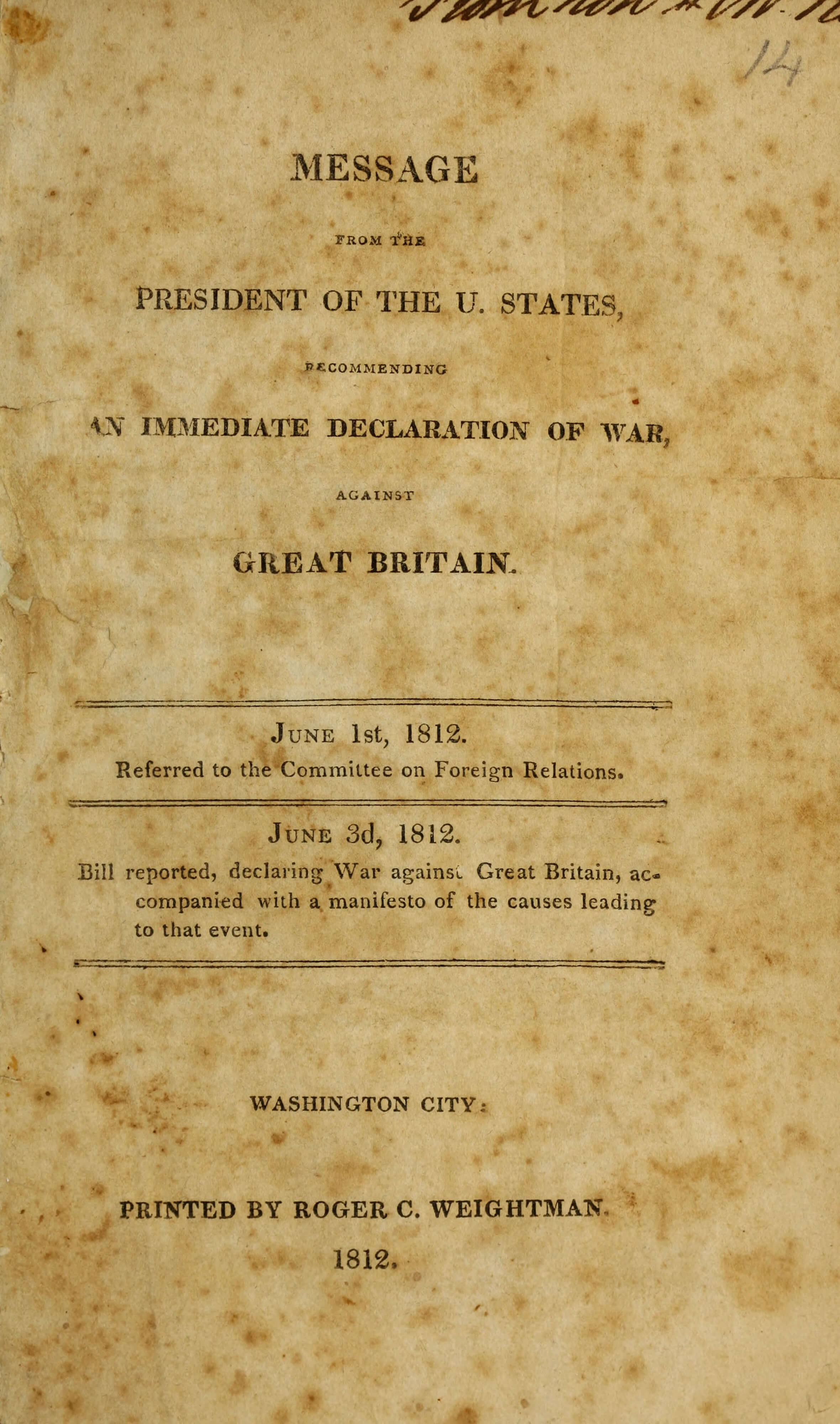
The first formal declaration occurred on June 18, 1812, when the United States declared war against the United Kingdom, citing British impressment of American sailors and violations of U.S. neutrality during the Napoleonic Wars. This conflict, known as the War of 1812, concluded with the Treaty of Ghent in 1814.
On May 13, 1846, Congress declared war on Mexico at the request of President James K. Polk, following territorial disputes and military clashes in Texas. The Mexican-American War resulted in the Treaty of Guadalupe Hidalgo (1848), which expanded U.S. territory to include present-day California, Arizona, and other southwestern states.
The Spanish-American War marked another instance of a formal declaration of war. The conflict was precipitated by the sinking of the USS Maine in Havana Harbor and growing tensions over Spanish colonial rule in Cuba. The war ended later that year with the Treaty of Paris (1898), which granted the United States control over former Spanish territories, including Puerto Rico, Guam, and the Philippines.
During World War I, the United States declared war on Germany on April 6, 1917, citing unrestricted submarine warfare and the Zimmermann Telegram, in which Germany attempted to persuade Mexico to join the war against the United States. Later that year, on December 7, 1917, Congress also declared war on Austria-Hungary, a German ally. The conflict formally ended for the United States with the signing of separate peace treaties with Germany, Austria, and Hungary in 1921.
World War II saw the most formal war declarations by the United States. Following the attack on Pearl Harbor on December 7, 1941, Congress declared war on Japan the next day, with near-unanimous approval. In response, Nazi Germany and Italy, led by Adolf Hitler and Benito Mussolini, declared war on the United States on December 11, prompting reciprocal declarations by Congress against both nations. In 1942, the United States further declared war on Bulgaria, Hungary, and Romania, all Axis-aligned nations. The war concluded in 1945 with the unconditional surrender of Germany and Japan, followed by formal peace treaties in the years after.
Each of these declarations was issued through a Congressional resolution, signed into law by the president, signifying the commencement of hostilities under the authority of the U.S. government. Since World War II, the United States has engaged in numerous military conflicts, but none have been accompanied by a formal declaration of war. Instead, Congress has authorized the use of military force through resolutions, such as those in Korea, Vietnam, and the War on Terror, including conflicts in Afghanistan and Iraq.
Undeclared wars
Military engagements authorized by Congress
In other instances, the United States has engaged in extended military combat that was authorized by Congress.
Military engagements authorized by United Nations Security Council Resolutions and funded by Congress
In many instances, the United States has engaged in extended military engagements that were authorized by United Nations Security Council Resolutions and funded by appropriations from Congress.
Other undeclared wars
On at least 125 occasions, the president has acted without prior express military authorization from Congress. These include instances in which the United States fought in the Philippine–American War from 1898 to 1903, in Nicaragua in 1927, as well as the NATO bombing campaign of Yugoslavia in 1999, and the 2018 missile strikes on Syria.
The United States' longest war, against the Taliban in Afghanistan, began in 2001 and ended with the withdrawal of American troops on 31 August 2021.
The Indian Wars comprise at least 28 conflicts and engagements. These localized conflicts, with Native Americans, began with European colonists coming to North America, long before the establishment of the United States. For the purpose of this discussion, the Indian Wars are defined as conflicts with the United States of America. They begin as one front in the American Revolutionary War in 1775 and had concluded by 1918. The United States Army still maintains a campaign streamer for Pine Ridge 1890–1891 despite opposition from certain Native American groups.
The American Civil War was not an international conflict under the laws of war, because the Confederate States of America (CSA) was not a government that had been granted full diplomatic recognition as a sovereign nation by other sovereign states or by the government of the United States.
War Powers Resolution
On March 21, 2011, a number of lawmakers expressed concern that the decision of President Barack Obama to order the U.S. military to join in attacks of Libyan air defenses and government forces exceeded his constitutional authority because the decision to authorize the attack was made without congressional permission.
See also
- Cold War
- Declaration of war by Canada
- Declaration of war by the United Kingdom
- Just War Theory
- Police action
- Timeline of United States military operations
- War on Terror
- War on Drugs
References
Further reading
- Grotius, Hugo (2004). On The Law Of War And Peace. Kessinger Publishing. ISBN 978-1-4191-3875-1.
- Edwin Meese; Matthew Spalding; David F. Forte (2005). The Heritage guide to the Constitution. Regnery Publishing. ISBN 978-1-59698-001-3.
- Kenneth A. Schultz, Tying Hands and Washing Hands: The U.S. Congress and Multilateral Humanitarian Intervention, Ch. 4, pp 105–142, in Daniel Drezner, Ed. Locating the Proper Authorities: The Interaction of Domestic and International Institutions, University of Michigan Press, 2003.
External links
- The House of Rep, Republican Study Committee of War and Military Authorized Conflicts. 2003.
- Declarations of war and votes
- Text of Declaration of War on Japan
- Text of Declaration of War on Germany
- Text of Declaration of War on Bulgaria
- Authorization for Use of Military Force — signed September 18, 2001
- House Joint Resolution Authorizing Use of Force Against Iraq — signed October 16, 2002
- Instances of Use of United States Forces Abroad, 1798–1993
- A partial list of U.S. military interventions from 1890 to 2006
- U.S.-Africa Chronology